


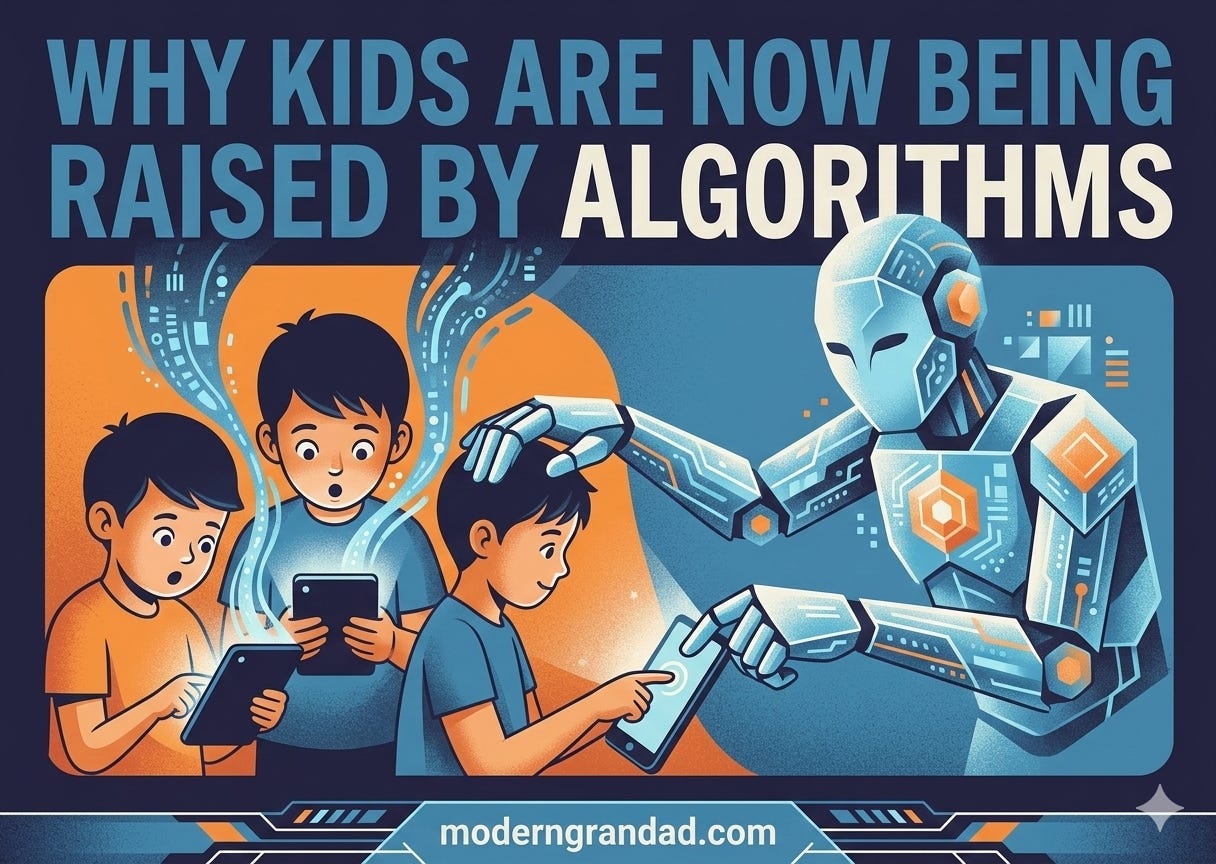
Here’s a strange thought.
If adults don’t set the boundaries for childhood…
algorithms will.
And increasingly, that’s exactly what’s happening.
The common explanation for rising teen anxiety is simple:
smartphones and social media are damaging young minds.
There’s truth in that.
The average teenager now spends around five hours a day on social media.
But blaming the phone alone misses something important.
Technology didn’t suddenly overpower families.
It mostly stepped into a space that had already opened up.
For most of modern history, family life followed a simple structure.
Adults set the rules.
Kids tested the rules.
Over the past few decades, something subtle changed.
Parents became more emotionally supportive — which is good.
But they also became less comfortable enforcing boundaries.
Researchers describe the result as a governance vacuum.
And just as that vacuum appeared…
the most addictive technology in human history arrived in every teenager’s pocket.
When adult authority steps back, something else always steps forward.
Today that “something else” is algorithms.
Many kids now take their cues from systems designed to capture attention…
not adults designed to build character.
This is where grandads may matter more than we realise.
Most grandads grew up in a world with clearer expectations.
Not always fair.
Not always gentle.
But one thing was rarely in doubt:
adults were in charge.
That memory matters.
Because children don’t just need affection.
They need reference adults.
Adults who are warm — but anchored.
Adults who listen — but still hold the line.
Adults whose presence quietly says,
there are boundaries here.
Grandads are uniquely positioned to play that role.
Not as disciplinarians.
Not as critics of modern parents.
But as something quietly stabilising:
a steady adult presence in a noisy world.
A simple place to start is curiosity.
Next time you’re with your grandchild, try asking:
“What’s the most interesting thing you’ve seen online this week?”
Listen first.
Then gently ask a second question:
“How do you decide what’s actually worth paying attention to?”
You’re not policing their world.
You’re helping them develop judgement.
That’s what reference adults do.