


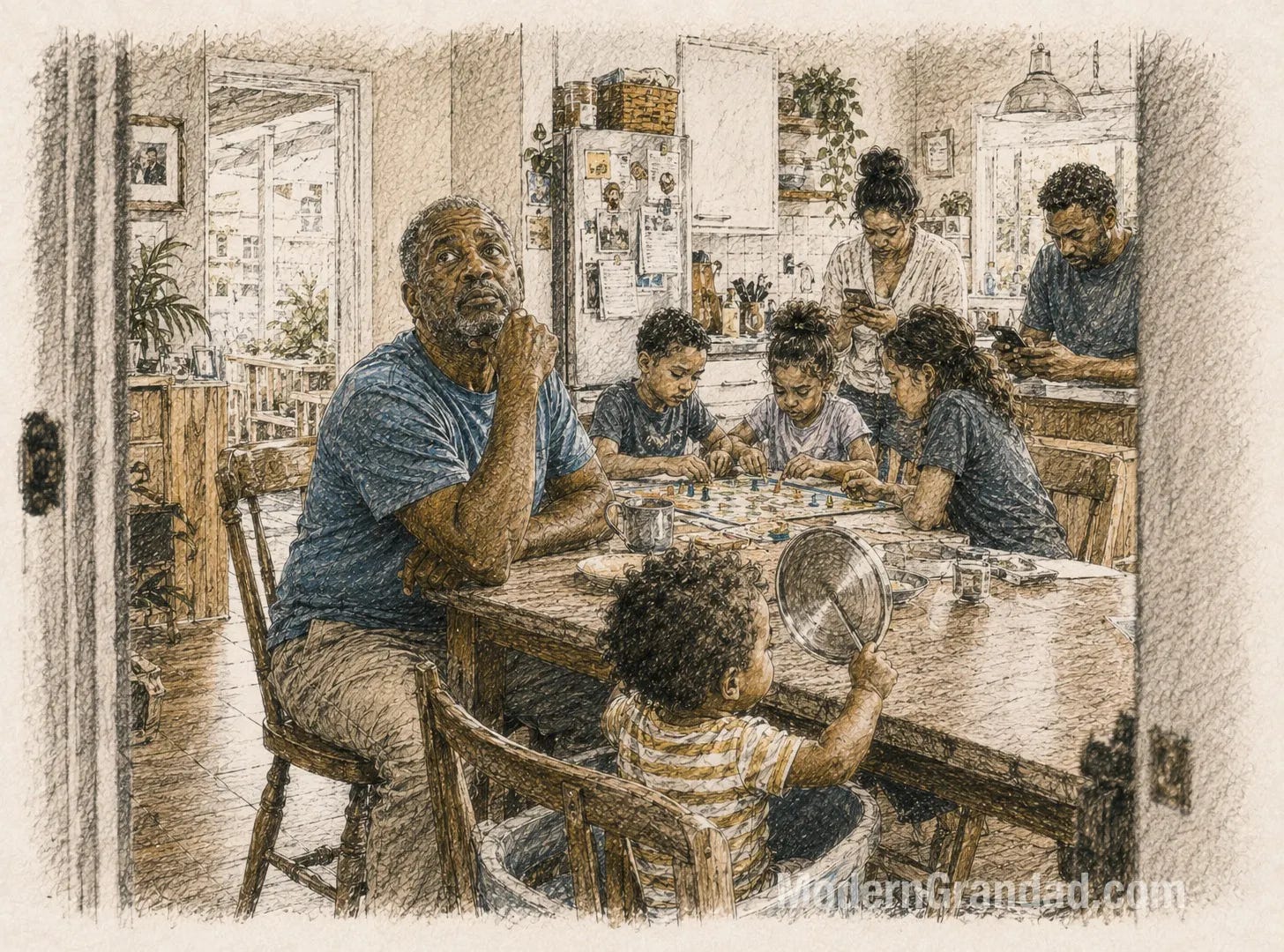
For most of history, age and information came as a package.
If you wanted to know how something worked, you found someone who had been around long enough to know. If you wanted to know how to grow something, fix something, build something or get through something, there was usually an older person who had done it before.
Grandad had an advantage. He’d been around longer. He knew things you didn’t.
That advantage has pretty much disappeared.
Grandad isn’t the smartest person in the room anymore.
Google has been outsmarting all of us for a while.
AI is now the undisputed smartypants.
What an extraordinary change we are living through.
Then: How do I get the information?
Now: What do I do with all this information?
Answers are everywhere. Instructions are everywhere. Opinions are everywhere. Explanations are everywhere.
So if knowing things is no longer Grandad’s great advantage, what is?
That’s the question I’ve been mulling over.
Age is not wisdom.
I’m suspicious of the traditional idea that getting older automatically makes you wiser.
It doesn’t. I know plenty of older people who haven’t learned much from being older.
And older people can be just as susceptible to rubbish, misinformation and poor judgement as anybody else. Experience doesn’t guarantee good judgement.
So I’m not interested in making Grandad sound like some wise old oracle dispensing the answers from the mountaintop.
But age does give you something a child doesn’t have.
More life.
You’ve had more time to experience things.
More beginnings. More endings. More things going wrong. More things working out. More decisions. More consequences. More surprises. More mistakes. More opportunities to discover that something you were certain about wasn’t quite as certain as you thought.
Age gives you experience.
Experience gives you pieces of the puzzle.
What you do with those pieces determines whether they become wisdom, perspective, judgement, a good story, a bad opinion, or absolutely nothing.
The value isn’t in simply being older.
It’s in what you have done with the life you’ve had.
What has Grandad had time to lose?
This might be one of the less obvious benefits of getting older.
Here are some things that I am happy to have lost along the way.
The belief that there is one correct career.
The belief that embarrassment is fatal.
The belief that everyone is thinking about you.
The belief that adults know what they’re doing.
The belief that a setback means your life is ruined.
The belief that changing direction means you’ve failed.
If you’ve actually lived through several chapters, you can develop a different relationship with uncertainty.
You discover that things change. People change. You change. The thing that seemed enormous at 25 can look very different at 55. Something you thought was the end can turn out to be the beginning of something else.
That doesn’t necessarily make you wise.
But it can give you perspective.
And perspective can be useful.
Especially to somebody who hasn’t lived long enough to have any yet.
Lived information
There’s another difference between what Grandad knows and what a child can find online.
That’s the difference between information and experience.
I can tell my grandson how something works. He can ask Google. He can ask AI. He can watch a hundred videos. That’s not inferior to what I know. In many cases, it’s vastly better.
But it isn’t the same thing as having lived it.
That’s not superior information.
It’s lived information.
I know what it’s like to make something. To break something. To try to fix something. To get something wrong. To discover that the thing I thought would take ten minutes takes two hours. To have an idea that doesn’t work. To start again.
That experience doesn’t make me smarter than my grandson.
But it gives me some pieces of the puzzle he hasn’t encountered yet.
And I can put those pieces on the table.
The Physical/Analog Bridge
This is something I’ve become increasingly aware of in my own grandfathering.
There is a whole physical world that can become strangely invisible when so much of life is experienced through screens.
Where does water come from? The tap.
How do you fix the car? Call roadside assistance.
How do you make something? Buy it.
How do you find out how something works? Look it up.
None of these answers is wrong. But there is something different about actually encountering the thing. Opening the bonnet. Holding the tool. Feeling the weight. Getting your hands dirty. Taking something apart. Trying to put it back together. Finding out that the instructions don’t quite match what is in front of you.
I’ve had the opportunity to experience a lot of that physical world.
And because I’ve lived in it, I can open the door into it.
I don’t have to teach a lesson.
I can just say:
Come and have a look.
Or:
Give me a hand.
Or:
Think we can fix this?
And suddenly the child isn’t learning about something. They’re encountering it.
That’s what I mean by the Physical/Analog Bridge.
It’s not digital versus analogue. I’m not nostalgic for a world before smartphones. I’m using smartphones. I use AI. I look things up. I learn from YouTube.
But I also want my grandson to have a relationship with the physical world that isn’t entirely mediated through a screen.
And I think Grandad can be useful there.
Translation
Here’s another capability I’m becoming interested in.
Translation.
Not translating French into English.
Turning complexity into something another human can understand.
The world is getting more complicated.
Children are going to encounter ideas, technologies, systems and problems that are difficult to make sense of. Information doesn’t necessarily solve that problem. Sometimes it creates it. The internet can give you ten thousand answers.
But which one matters? Where does it fit? What’s the bit I need to understand? What’s missing?
A good human translator can help.
And human translation has an advantage when the translator knows the person receiving the explanation.
I know what my grandson already understands. I know what he’s curious about. I know when he’s pretending to understand. I know which analogy might make something click.
Age itself doesn’t make you a translator.
It’s a capability a Modern Grandad can develop.
And perhaps that’s the point.
The future doesn’t need Grandad to know everything.
It needs him to remain useful. Curious. Open. Interested enough to keep learning himself.
A longer life
So I’m coming back to the question:
What does a longer life give Grandad that can be useful to a child?
Not superiority. Not authority. Not automatic wisdom.
Experience.
A longer life gives you more chapters. More encounters. More mistakes. More things you’ve seen change. More pieces of the puzzle.
And if you’re willing to put some of those pieces on the table, rather than insist that you have the whole picture, they might be useful to somebody whose puzzle has only just begun.
That’s what I increasingly think Grandad is still good for.
Not having all the answers.
Bringing another life into the room.
And sometimes opening a door the child didn’t know was there.
Come with me.