


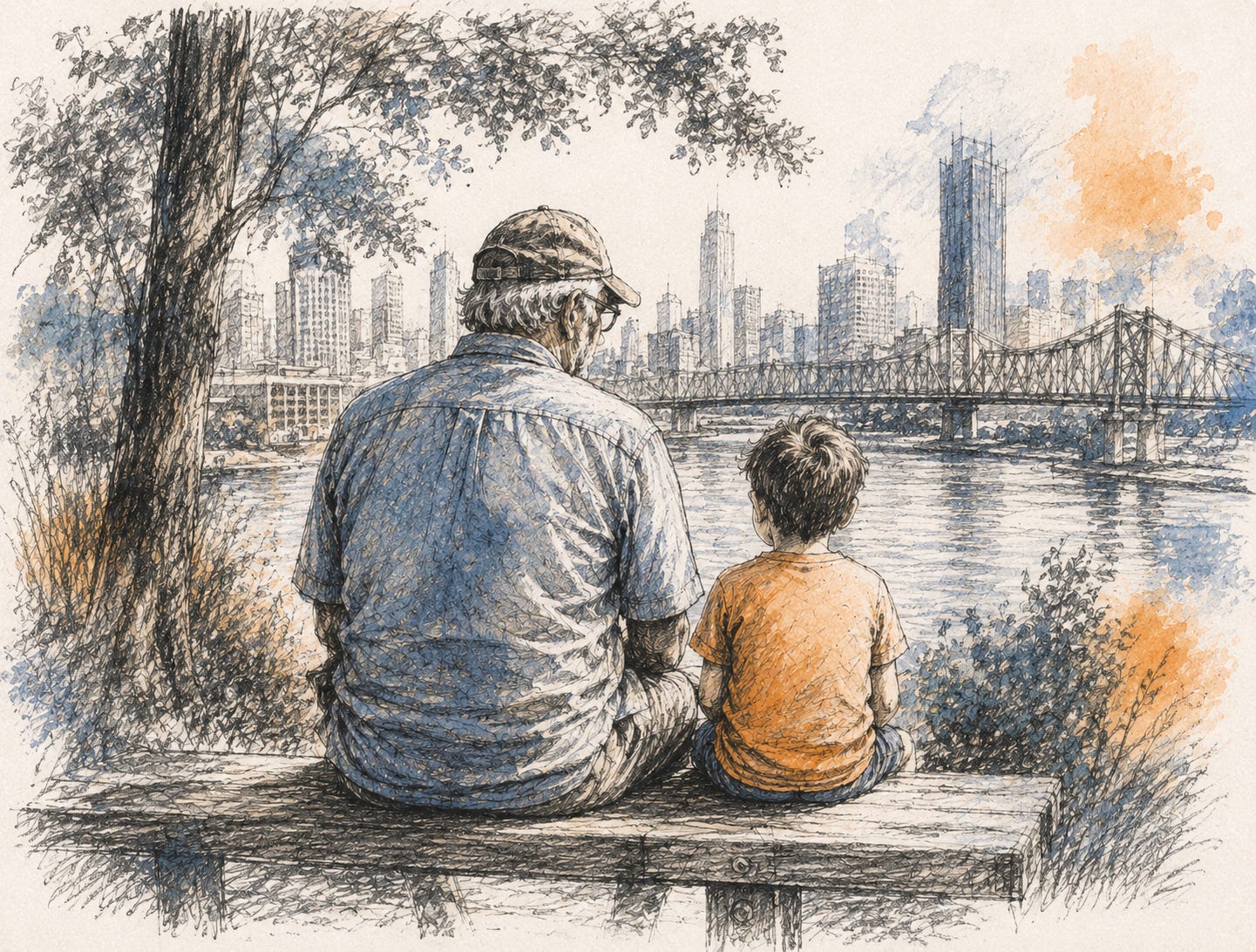
When was the last time you actually saw a steam train? Probably a while ago.
What about on a roadside sign? Have you noticed that in Australia, many railway crossing signs still show a steam train? But we don’t have steam trains. We have electric trains.
The old image remains because we all know exactly what it means. It’s cultural shorthand.
I think we’ve done the same with Grandad.
I stumbled onto this realisation when I began writing about my journey as a grandfather. I needed pictures to go with the words, so I did an online image search for grandfather.
I hoped to find images of, well, sort-of-me: an energetic first-time grandad in his early sixties. Instead I found old men. Snow-white hair. Knitted vests. Rocking chairs. Walking sticks.
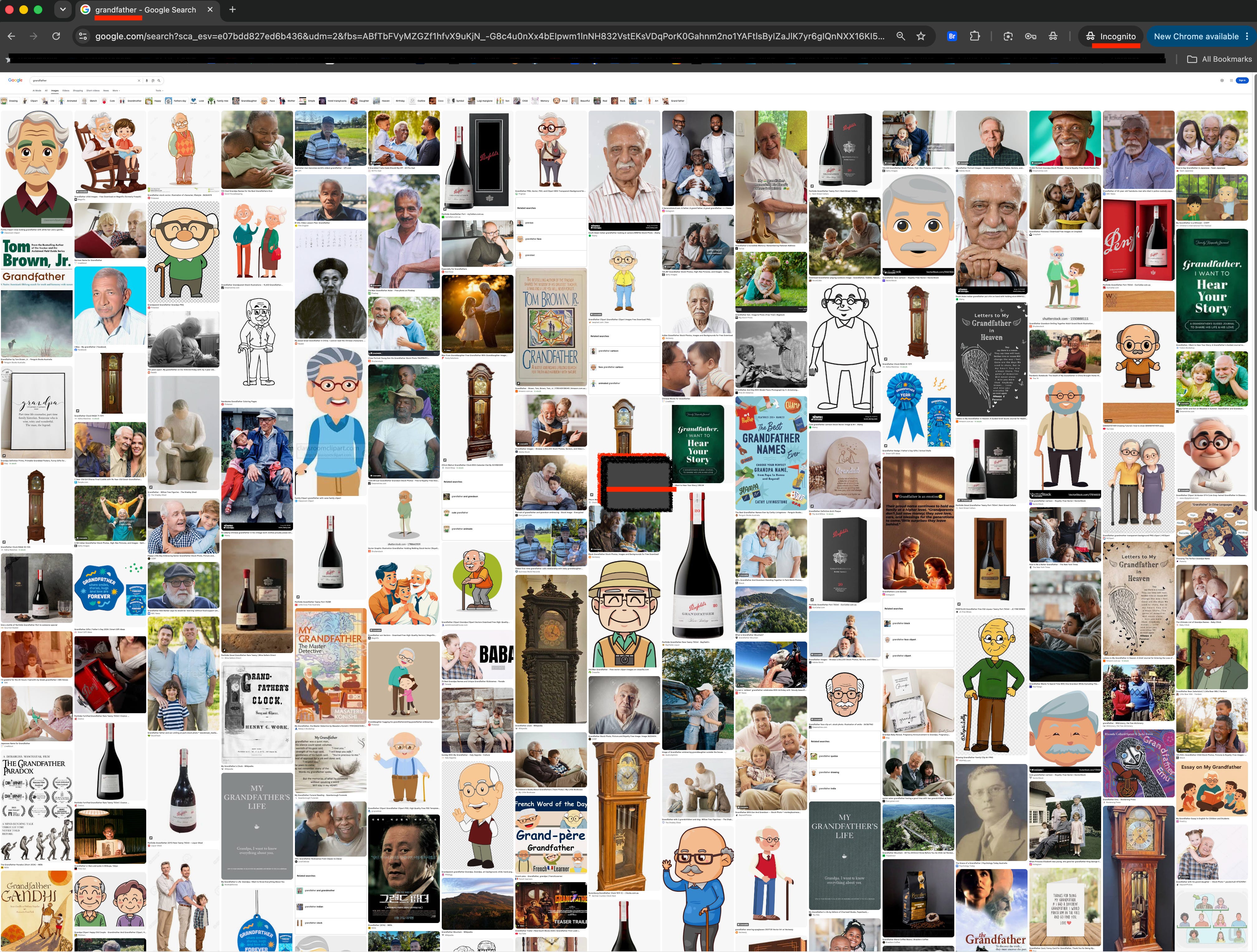
Is that how the world sees me? Another steam train?
I was offended. I’ve proudly kept up with a world that hasn’t stopped changing since I was a kid. Ducking and diving and weaving and reinventing myself. But does that all account for nothing once you reach a certain age? Am I being shelved? I don’t feel out of date. Suddenly I felt categorised. (Is this what women have been saying all along? This male finally gets it.)
Chastened, a bit deflated, but curious, I started digging. How had the world moved on while our idea of Grandad stayed behind?
Let’s go back to 1950.
Not because 1950 was some golden age of grandfathering. It wasn’t. But it’s a useful line in the sand. The 75 years since are roughly a human lifetime. I can get my head around that. Plus, I can see myself there. The Second World War was over. The postwar economic boom was beginning. The modern Western middle class was expanding. Think cities surrounded by suburbs, families and cars. That still feels familiar.
And somewhere in one of those suburbs was Grandad.
His world looked very different from mine.
As a Dad, he was expected to provide. Women did most of the caring. Children had considerably more freedom to roam without direct adult supervision.
There was no internet. No social media. No parenting influencers. No smartphones. No algorithm competing for a child’s attention.
Knowledge itself was harder to obtain. If you wanted to know how to repair something, grow something, make something or understand something, an older person who had spent 60 years accumulating knowledge could be genuinely useful.
And then there was Grandad himself. He didn’t necessarily become a grandfather much younger than we do or shuffle off soon afterwards. That’s too simple. But he lived in a world where healthy later life was shorter, and retirement wasn’t yet the twenty-year life stage it can be today.
On average, there was simply less life on the other side of sixty.
Then the world changed.
Actually, almost everything around Grandad changed.
Childhood changed.
But not in the way I thought.
I’m wary of romanticising the childhood I grew up in. You know, ‘we started roaming after breakfast and just had to be home before the street lights came on.’ A common story. It’s my story too.
But who’s to say it was better? It’s like the vinyl records vs digital music argument. It’s subjective, nuanced, and there’s no simple evidence that says one childhood was better than the other.
But there is plenty of evidence that childhood changed.
Children became less independent.
Kids once walked to school, rode bikes around neighbourhoods, went to friends’ houses, played in streets and disappeared for hours before someone yelled their name from the front door.
Over the decades, that freedom shrank. Childhood became more supervised, more organised, and eventually, more digital. That’s progress. I’m for progress. But something else quietly disappeared with it.
Children spent less time simply inhabiting the ordinary adult world.
There were once all sorts of adults on the edges of childhood. An informal network of local adults. The neighbour fixing his fence. The woman behind the counter. Someone working on a car. Someone gardening. The neighbour handling everyday situations.
They weren’t trying to teach the kids anything. They weren’t coaching them. They weren’t developing them. No metrics. No testing. No pass or fail.
They were just everyday adults being adults while children happened to be around.
That kind of casual adult contact doesn’t seem to be as common these days.
And while childhood was becoming more managed, something else happened.
Parenting changed.
Parents didn’t become less involved. They became more involved. And the job got bigger.
The basics remain. Feed them. House them. Love them. Keep them safe.
Those things didn’t disappear. But we just kept adding to the list.
Their emotional development matters. Their confidence matters. Early learning matters. Nutrition matters. Friendships matter. Mental health matters. School performance matters. Future opportunities matter.
Worth a special mention is parents’ new job: managing the digital world. Deciding about screen time, smartphones, social media, gaming, online pornography, cyberbullying, online predators, algorithms and now AI.
And there’s a twist. Today’s parents are responsible for supervising an environment their own parents never had to navigate. And unlike teaching a child how to cross a road, the parents themselves are learning the rules while trying to teach them.
All of the above are sensible things to care about. But there’s a cost to an ever-expanding job description. More ways to feel like you’re getting it wrong. Now it seems there’s a never-ending list of things a good parent feels responsible for getting right.
Meanwhile, more mothers entered paid work while fathers became more involved at home. It’s common for both adults to work. Both somehow also have to run the family.
So families became busier, parents were stretched thinner, and the job description of parenting kept expanding.
The job got bigger.
Then something else changed.
Men changed.
I remember my father recoiling from the question, almost scraping the chair backwards over the floor when I asked him if he attended my birth. His exact words have left me, but ‘that’s women’s business’ is close.
By the time I became a father in 1992, attending the birth was pretty much normal. And it didn’t stop at the delivery-room door. I changed nappies, pushed prams, fed bottles. There was bath time, school events and talking about feelings in a way I don't remember doing with my father. It would be unfair to my wife to say I equally shared this part of parenting. But I willingly showed up.
The old expectation that a good man should provide didn’t disappear. Another expectation was added. Provide and participate.
I’m 65 today. Born 1961.
I had a mechanical, analogue, and fix-it-if-it’s-broken childhood. Our TV set had knobs you twisted and pulled, rabbit-ear antennas that required one of us kids to hold on to them. That’s only if we wanted to see Hogan’s Heroes without the snowstorm of dots.
I was an adult when home computers arrived. Then the internet. Email. Mobile phones. Smartphones. Social media. Video calls. Remote work. Now artificial intelligence.
Mine is not a generation of men new to change. We’ve been adapting all our adult lives.
And now, we are becoming grandads.
Longevity changed.
We’re also living longer.
But that’s only half the story. We’re having children later too, which means we’re becoming grandparents later. You might expect those two things to cancel each other out. But for many of us, there can still be decades of healthy grandfatherhood ahead.
Yay! My grandson was born two years ago. I’m already wondering what we’ll be doing together when he’s five. Ten. Fifteen. Twenty. Twenty-five. Maybe even when he becomes a parent himself. It’s possible. I can imagine it.
I’m not planning on guest appearances in my grandson’s life. I’m eating my veges and aiming for a recurring role in his family’s long-running cast.
And then there’s one final change.
Work and retirement changed.
Many grandads today are still working. They may be running businesses, managing people, teaching, building, solving problems, making decisions.
Then, somewhere during their grandad years, work begins to wind down.
Retirement is different for everyone. Some men can’t wait. Some are pushed early. Some never really retire. Some flourish. Some struggle. I’m not suggesting we all retire and immediately have an identity crisis. But I do think work has spent 40 years giving us one message over and over.
You’re useful here.
Someone needs your answer. Someone needs the machine fixed. Someone needs the report. Someone wants your opinion. Someone expects you tomorrow morning.
Then one day, the automatic job description disappears.
But the man doesn’t.
I’m that man. I can see work eventually asking less of me. But I don’t see myself having less to give.
So let’s pull all five changes together.
Childhood changed.
Parenting changed.
Men changed.
Longevity changed.
Work and retirement changed.
Almost everything around Grandad moved. And yet somehow our cultural picture of him is still sitting in the rocking chair.
The picture doesn’t tally with the world I found in my research. It doesn’t reflect the conversations I’ve been having with other grandads. I don’t think Grandad is out of date.
I think the picture is.
So if the old job description no longer fits, what is Grandad for now?
I don’t think the answer is to give him a bigger to-do list.
Quite the opposite.
Maybe Grandad doesn’t need to do more things for the child.
Maybe the opportunity is to let the child do more things with Grandad.
This idea has changed how I think about and approach grandfathering.
I want to be honest about myself for a moment. It’ll help put in context what I’m going to suggest.
I can be overly enthusiastic when I'm interested in something new. I joke that I would be an unbearable religious convert. I also overthink and overdeliver. Ask me the time and I'll happily tell you the history of the watch. I brought all of that to becoming a grandad.
I had lists of ideas. Things to do together. Interesting knowledge to pass on.
Hmm? I’m pausing that for a bit.
In my enthusiasm, I’d overlooked something simpler.
What if we just let children into our lives?
Going to the hardware store? Bring them along.
Cooking dinner? Bring them along.
Fixing the gate? Bring them along.
Walking the dog? Bring them along.
Helping a neighbour? Bring them along.
Trying something you’ve never done before and making a complete hash of it? Definitely bring them along.
Then, while researching this post, something else occurred to me.
Grandad used to know stuff.
For centuries, one obvious role for an older person was information. They were the ones who had accumulated experience. Knowledge was scarce. If you’d been around for 60 years, you’d probably encountered things a child hadn’t. You were a go-to source for information.
Today?
A child can access more information in ten seconds than Grandad could accumulate in ten lifetimes.
Want to know how to fix something around the house?
YouTube will probably explain it better than Grandad.
But YouTube can't let the child watch Grandad struggle to fix something he doesn't know how to fix.
That’s different.
“That’s odd.” “Maybe it’s this.” Nope. Try again. Wrong tool. Gr-rrr. Walk away. Come back. Try something else. Eventually: “Good as new. Like a bought one.”
What did the child just learn? About fixing things? Probably not much. About what an adult does when he doesn’t know what to do. Lots.
I don’t want my grandson to believe that capable adults always know the answer. I want him to see that capable adults find a way forward when they don’t.
I don’t know how to teach him resilience. But he can watch me struggle through.
I don’t want to lecture him about curiosity. But he will hear me say: “I don’t know. Let’s find out.”
I don’t want to tell him to be brave. He can see me uncomfortable and doing it anyway.
I don’t want to pretend I’ve got life sorted. He’ll discover, in his own time, that I haven’t.
I just need to live my life with the door open.
That’s what I’m beginning to mean when I say:
Grandadding can be more than a hobby. It’s leadership through example.
Not:
I know better. Follow me.
Not:
Sit down and listen to Grandad’s wisdom.
Something quieter. Something that shows there’s another way to approach life. And that brings me back to something I wrote before I understood any of this research.
I called it The Pledge.
I pledge this modern inheritance to you.
Not money.
Not words.
But the quiet, consistent example of how I choose to live.So at ten,
you begin to take life in your stride.And at twenty,
you’re ready to take on the world
because you’ve seen…When I’m angry, confused, or scared—
and I don’t know what to do next—I don’t need to have
the courage of a lion
the wisdom of Buddha
the confidence of a Formula 1 driver.I just need
a bit of spine
a willing mind
a daily dose of mild discomfort.And I find a way.
When I first wrote that, I thought the inheritance was something I would have to teach him.
Now I wonder if I just need to let him close enough to watch me live it.
Which brings me back to the steam train.
There’s nothing wrong with that old railway sign. It still works. We see it and instantly know what it means. But we’d be foolish to look at the sign and assume that the next train coming down the tracks looks like that.
Maybe it’s the same with Grandad.
The cardigan can stay. The snow white hair can stay. I’ll even forgive the little glasses.
But the man underneath the symbol has changed enormously.
So what are grandads for now? I’m still figuring that out.
But I don’t think my grandson needs another expert. He doesn’t need me to compete with Google. And he certainly doesn’t need me pretending I’ve got life sorted.
I think my job is much simpler.
Keep living.
Keep learning.
Keep getting things wrong.
Keep finding a way.
And every now and then, look over my shoulder and say:
Come with me.
Where this started
What Are Grandads For Now? is the question I’ve arrived at. But Modern Grandad started with a much more personal one: what kind of grandad do I want to be?
I wrote my way through that question in seven short posts.
Start here →
