


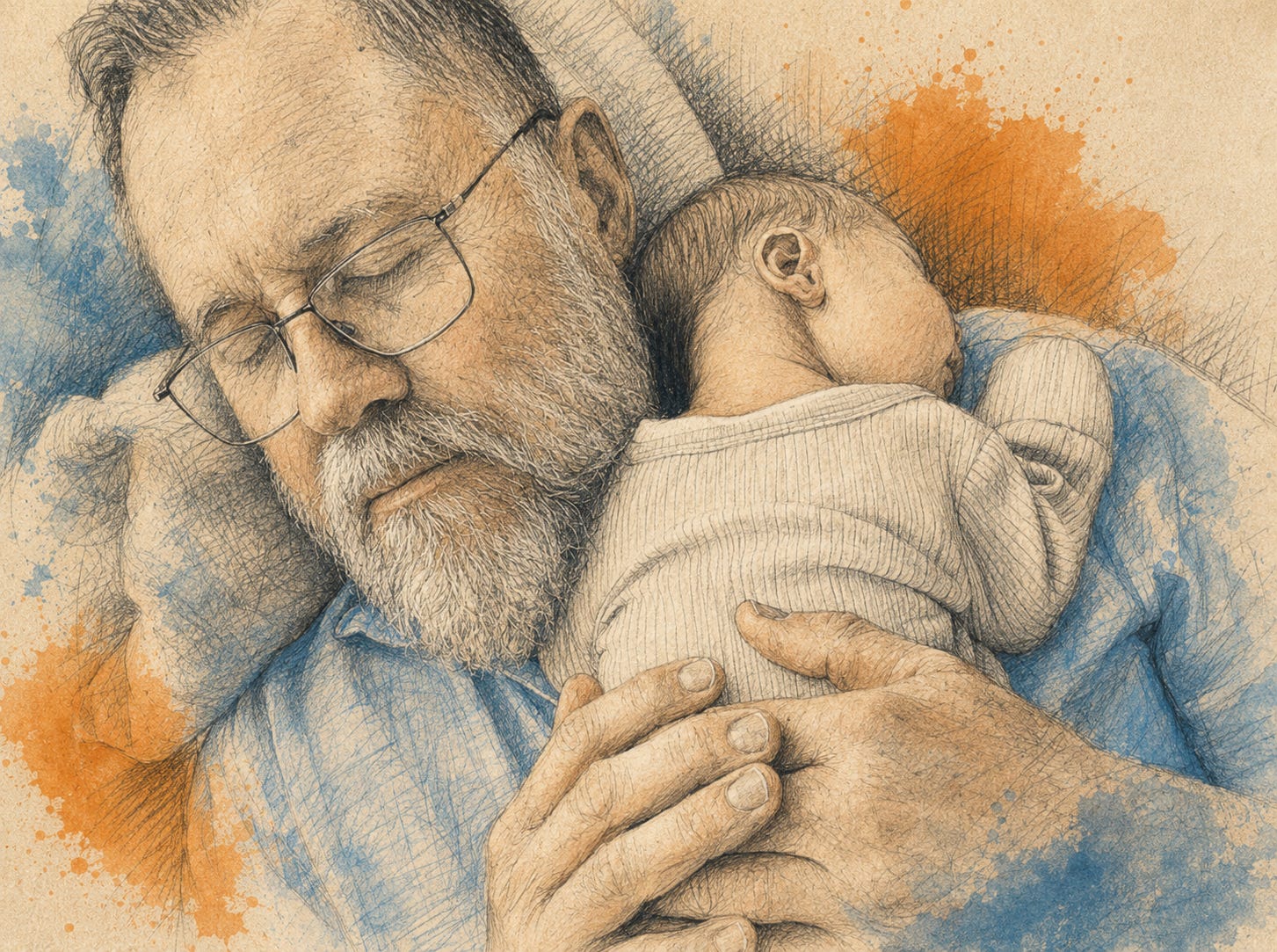
Twenty-three months ago, my first grandson was born. When I first held him, I fell in love, and I whispered, “I’m going to be the best grandad I can be.”
Now, I didn’t know how, but I was willing to learn.
And I was sort of excited because—talk about getting the timing right—more grandads are walking the earth right now than at any time in human history. That’s roughly 700 million grandads to call upon to show me the way. If you gathered them all into one place, they would form the third-largest nation on the planet—more than the populations of the US, Indonesia, and Pakistan combined.
So, twenty-three months later, why can’t I find them?
I started by looking online for groups. I found groups for older men who are lonely, but I’m not lonely. I found groups for grandparents who are looking after grandkids full-time, called kinship carers, who often need financial and in-person assistance. I need neither. Then I got excited when I found a prominent grandparenting conference, only to be deflated when I realised their primary goal is to pass on a religious legacy. I don’t have an agenda. I just want to be a role model to my grandson, support his parents, grow as a person, and do it with like-minded men.
Hmm. A book might give me answers. I found no granddadding titles. There’s a swag of grandparenting books out there, but they were either written for grandmothers, relationship-focused, or heavy on research. Some had a token section devoted to grandfathers—you know, a “let’s not forget grandad” chapter.
I wanted a how-to guide to build a capable grandson. I wanted ideas on how to offer young people alternatives to the poorly thought-out ideas of the Manosphere. I wanted a book full of possibility and the future, not nostalgia and recycled advice like “take your grandkids to the movies.”
Alright then, looks like I’ll have to start my own group. I called it the New Grandad Club. It was meant to be an easy afternoon for grandads and grandkids to chase, chill, and chat. I ran a six-week campaign across ten Facebook community groups, through three local council offices, and on public notice boards. It was enthusiastically supported by… women.
“Such a fab idea!” “This one’s for you, Dad!” “Love love love this!”
Men? Not so enthusiastic. Two turned up, but they were two friends I had practically begged to come along so I didn’t run the risk of looking like Nigel-no-friends.
I know, I’ll speak to civic groups like the Lions Club. Maybe they’re interested in a partnership. I spoke. I inspired them. But they were committed to established projects like sausage sizzles once a month at the local big-box hardware store. I got a pat on the back and a “good luck” as I walked out the door.
Time to think bigger. I approached people who have created social enterprises to see what they thought. They saw potential to turn this into a service that helps fulfil State and Federal government health objectives for older Australian men. But I didn’t want that. I just want to be a role model for my grandson, support his parents, grow as a person, and do it with like-minded men. With no hidden agenda.
So here I am. My grandson is about to turn two, and I feel alone in a world of 700 million grandads. I’m not sad. I’m not hurt. But I’m not finished. I’m curious.
Is “Grandad” Out of Date?
I can’t be the only person thinking this way. There are 700 million grandads on the planet. If only 1 in 1,000 men think the way I do, that’s 700,000 people—the population of a major city. So if I’m failing to reach even one man, then I wonder: am I speaking the wrong language to someone who isn’t really there anymore?
Just who is a Grandad in 2026?
An identity problem?
How we see grandfathers feels like it is stuck somewhere in the middle of the last century. The popular image of a grandparent is often someone in their late 60s or 70s, but the statistical reality is much younger. The average age for an Australian man to become a grandfather falls between 56 and 60.
A design problem?
As governments worldwide push retirement ages higher to combat aging populations, the working grandfather, it seems, is becoming the universal norm. In Australia, you can get the Age Pension at 67, while the average actual retirement age for men is 63 to 65. So most men spend their first 5 to 10 years as a grandfather while still working. Are they balancing career with a desire to be more present in their grandchildren’s lives?
An invisibility problem?
Despite working, midlife men are heavily relied upon. Nearly a third of working parents rely on grandparents as their primary source of childcare when returning to work. Then there’s the “triple load”: maintaining their own employment, providing hands-on care for grandchildren, and frequently supporting their own aging parents.
So it seems that while midlife men are silently grandadding in the background, they are trying to apply a 1980s grandparent model to a 2026 life pattern.
Maybe that’s how they like it. Maybe I’m poking a bear that doesn’t want to be poked.
What Do Midlife Men Actually Want?
If you ask men in their 50s, 60s, and beyond what they want out of the next chapter of their lives, their answers usually boil down to three things: Purpose & Legacy, Autonomy & Freedom, and Deep Connection.
Men think that to achieve these, they need to stay relevant in business or find a purpose through a hobby like fixing up old cars. They love the idea of having no boss, no schedule, and no expectations. Many feel the isolation that hits post-retirement, when work friendships fade, so they look to clubs and groups for connection.
But here’s where I see the irony.
I’ve found my Purpose & Legacy, my Autonomy & Freedom, and my Deep Connection by simply showing up for my grandson. I’m mentoring the next generation directly. I see it as a leadership role, not a hobby. I’ve reinvented myself as a guide, operating entirely outside the stressful metrics of career production. I’ve built a wonderful, unconditional bond with a child that keeps me current and a socially integrated part of my family.
Being a Modern Grandad has helped me find meaning, structure, and connection. I feel it is possibly my most important work yet.
What Is Stopping Men from Engaging More?
A radio producer asked me, what’s stopping men from stepping up as proactive grandads? I didn’t have an answer. So I dug in online. Here are four invisible barriers:
The “Support Staff” Illusion: Many men view grandparenting as an extension of domestic labour—changing nappies, managing schedules, and enforcing rules. Because they historically left domestic management to their partners, they assume they don’t have the skill set, or they view it as “women’s work.”
The Fear of Getting It Wrong: Modern parenting styles are different. Many older men look at these new rules, get intimidated by the fear of “doing it wrong” or causing friction with their adult children. It’s safer to stand back.
The Lack of a Roadmap: Unlike women, who possess distinct biological signposts like fertility, childbirth, and menopause to naturally mirror the transitions of life, men have only puberty. Without biological markers to announce the shift into elderhood, modern men default entirely to an institutional map dictated by school, career, and retirement. They miss out on a tribal ritual to transition them from the role of “Warrior” (provider) to “Elder” (anchor).
Few Role Models: Because grandparenting infrastructure is heavily matriarchal, retired men rarely see active, powerful archetypes of themselves serving as developmental guides.
I think there is a real need to reframe the whole identity around being a grandad. To say: you aren’t just babysitting; you are intentionally guiding a child’s future. It’s not a demotion from provider; it’s a promotion to elder.
What a Bloke Like Me Would Do…
In my two years of searching for like-minded grandads, what has struck me most is that I felt nothing out there was speaking to me. As a man. A regular bloke.
So I would like to offer alternatives to the traditional caregiving language—words like nurturing, helping out, minding the kids, or babysitting. When I read those, it makes me feel—rightly or wrongly—like a commodity. I want to offer more than that.
Agency, leadership, legacy, and adventure. That’s my language. Here’s an idea. What if we translate grandparenting into a dialect that aligns with how men are socialised to find value: through challenge, competence, and building things?
A man’s day job rarely reflects his actual soul. Work is often just a placeholder for purpose. Can we use this phase of life to offer a “second chance” for men to step into personas they always wanted to inhabit, but never got the opportunity to play in the professional world?
A corporate lawyer might have secretly dreamed of being a performance coach. A school teacher might have always wanted to be an explorer. Just by changing the way we frame it, can we at least get more men into the conversation?
I asked AI to give me a list of descriptors based on how a man naturally approaches and processes the world. Look at this list through the lens of the older man in your family’s life. Is there a version of himself he is waiting to unlock?
The Archetypes of Granddad Leadership
The Master Builder – For the man who wants to lay solid foundations, assemble character, and construct things that last.
The Creative Director – For the man who wants to shape the vibe, the culture, the imagination, and the vision of the family.
The Storyteller – For the custodian of identity, history, and the deeper meaning of where the family came from.
The Anchor – For the unshakeable, grounding presence who provides safety and stability when the world gets chaotic.
The Navigator – For the map-reader who helps the next generation read the terrain, spot the pitfalls, and find their true north.
The Performance Coach – For the mentor focused entirely on unlocking potential, building resilience, and sharpening mindset.
The Senior Partner – For the trusted advisor who stands shoulder-to-shoulder with the parents, offering high-level wisdom without micro-managing.
The Explorer – For the champion of curiosity, unstructured play, risk-taking, and outdoor adventure.
The Trustee – For the ultimate custodian of value, acting out of deep trust, integrity, and protective care.
The Catalyst – For the man who wants to spark energy, curiosity, and new ideas in a child’s life.
Some of you might be rolling your eyes. The nappy needs changing and you’re asking us to indulge men in childhood fantasies? Of course, we have to keep it real. Someone has to change the nappy. Everyone benefits when men do their share.
But words are persuasive. Maybe don’t ask him to babysit. If you are an adult child trying to get your dad to step up, have a go at changing the way you invite him into your world.
Something like ‘You know, I always think of you as the master builder, you always seem to me to be building things that last. I’d love to see you bring some more of that into the family…’
I think we are all better off with more modern grandads around. So regardless of what it said on his old business card, help a man in your life become one.
—
I’m stumbling my way through this. I’d love for you to share your ideas and insights and support. If you speak up, I’ll listen.
Also it’s real hard with current push to be independent of kids to get a look in.