


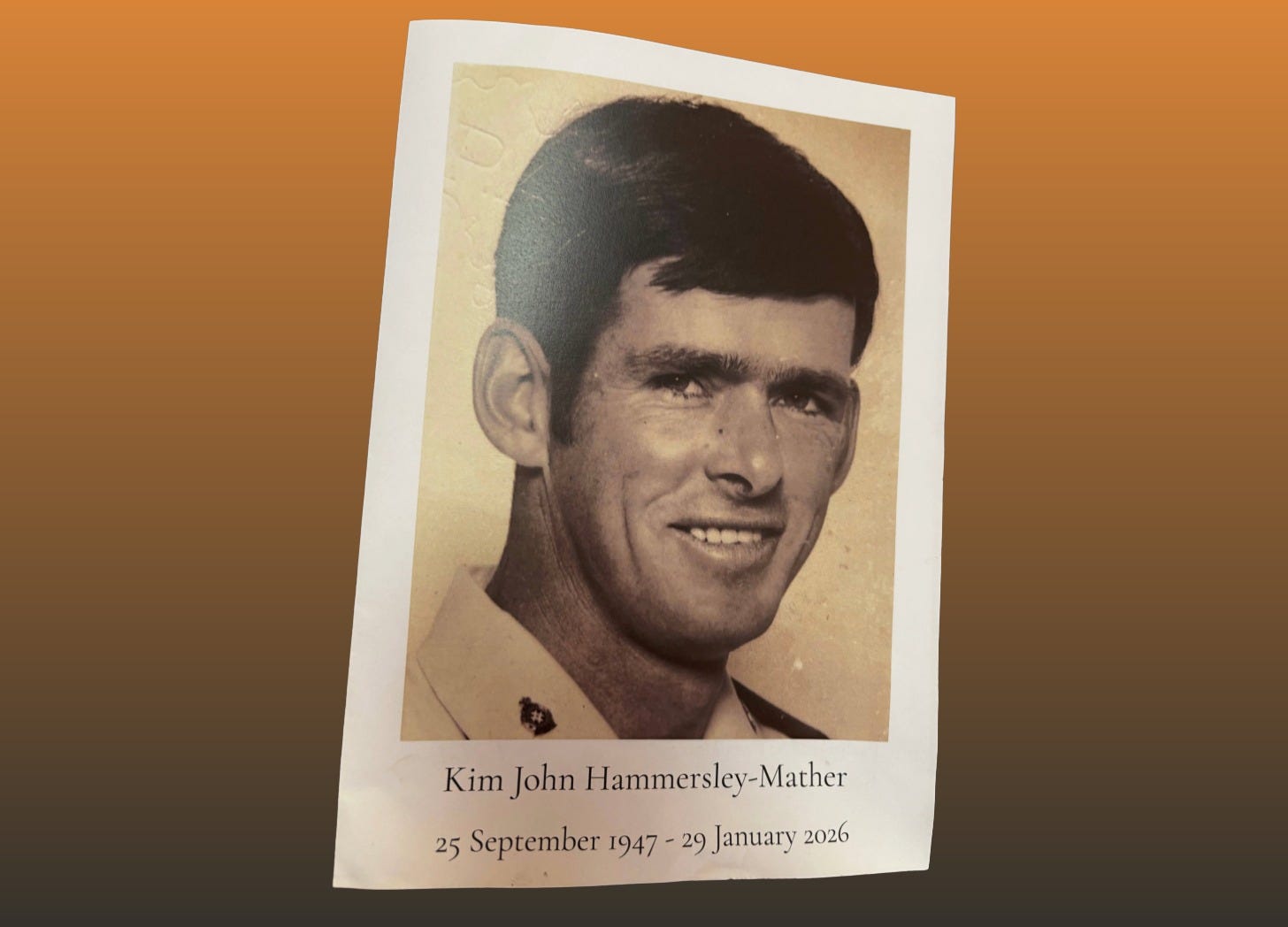
My dad and Kim’s dad were half-brothers.
So Kim and I were… sort of cousins.
But how could that be?
I’m eight.
And he’s… grown up.
I’m thinking this on a sandy bend of the Condamine River.
I’ve got a knife in my hand.
That feels very adult to me.
My country “cousin” Kim is telling me to gut the fish.
I’m gagging.
He says,
“You’ve got to learn to gut a fish.
You can’t get through life without it.”
I’m thinking, I just want to go home.
But I’m also thinking,
I just want to be like him.
Capable.
I’m seventeen.
Still a boy.
Desperately wanting to be a man.
And I need a man to show me how.
I know where one is.
Kim and Carmel are living on a boat—
a trimaran no less,
how exotic to a landlubber like me—
in the Brisbane River.
So I ride my bicycle to the pontoon.
I watch the other boat people—
do you call them sailors?—
row ashore.
And I wait.
For days.
Then I see Kim rowing in.
Easy to pick.
Clean-cut hair.
Standing out among the straggly locks and beards.
He says,
“Hey mate, what are you doing here?”
I say,
“Just passing by.”
I’m lying.
I wriggle my way into their life for a year.
I’m so inspired by Kim that I want to be a sailor.
But life teaches me otherwise.
I get terribly seasick.
So I leave the sea
and turn my interest to the mountains.
But Kim never leaves me.
He’s my first real mentor.
And he teaches me something I still live by:
Accountability isn’t punishment.
It’s power.
Now I’m in my late twenties.
I’m married to Vicky.
I’m standing next to the Caboolture River,
under a flimsy, wood-framed structure
with a rusty galvanised tin roof.
Sailors call these “sheds,” apparently.
There’s a stack of hundreds of pieces of wood.
About ten of them are nailed together.
I ask,
“What is it?”
Kim says,
“It’s my boat.”
I say,
“But how…
how do you know how to build a boat?”
I have no building skills.
“It’s inconceivable.”
He says,
“I just ask and learn.”
And there’s my second lesson.
Stop waiting to be taught.
Not long after that,
Vicky and I buy a wreck of a house.
We restore it.
We still live there today.
The last time I have a good talk with Kim,
I’m fifty-ish.
We’re sitting below deck
while Vamp is in dry dock.
Kim’s got a sanding mask below his chin.
He’s dusted in white.
We’re just two men now.
Talking life.
We argue philosophy
and realise we’re very much on the same page.
He says,
“Have you read the book Wanderer by Sterling Hayden?”
I say,
“No.”
So he digs through boxes.
Finds a book.
Thumbs through it.
Then he points to a passage and says,
“Read this.”
It remains, to this day,
my favourite piece of prose ever.
And to me—
it sums up Kim
perfectly.
‘To be truly challenging, a voyage, like a life, must rest on a firm foundation of financial unrest. Otherwise, you are doomed to a routine traverse, the kind known to yachtsmen who play with their boats at sea... “cruising” it is called. Voyaging belongs to seamen, and to the wanderers of the world who cannot, or will not, fit in. If you are contemplating a voyage and you have the means, abandon the venture until your fortunes change. Only then will you know what the sea is all about.
“I’ve always wanted to sail to the south seas, but I can’t afford it.”
What these men can’t afford is not to go. They are enmeshed in the cancerous discipline of “security.” And in the worship of security we fling our lives beneath the wheels of routine - and before we know it our lives are gone. What does a man need - really need? A few pounds of food each day, heat and shelter, six feet to lie down in - and some form of working activity that will yield a sense of accomplishment. That’s all - in the material sense, and we know it.
But we are brainwashed by our economic system until we end up in a tomb beneath a pyramid of time payments, mortgages, preposterous gadgetry, playthings that divert our attention for the sheer idiocy of the charade. The years thunder by, The dreams of youth grow dim where they lie caked in dust on the shelves of patience. Before we know it, the tomb is sealed.
Where, then, lies the answer? In choice. Which shall it be: bankruptcy of purse or bankruptcy of life?’